Allergy and intolerance
IgE-allergenen mix groot
A broad panel of IgE tests against inhaled and food allergens; shows sensitization, not allergy.
Everything about this testWhat it measures
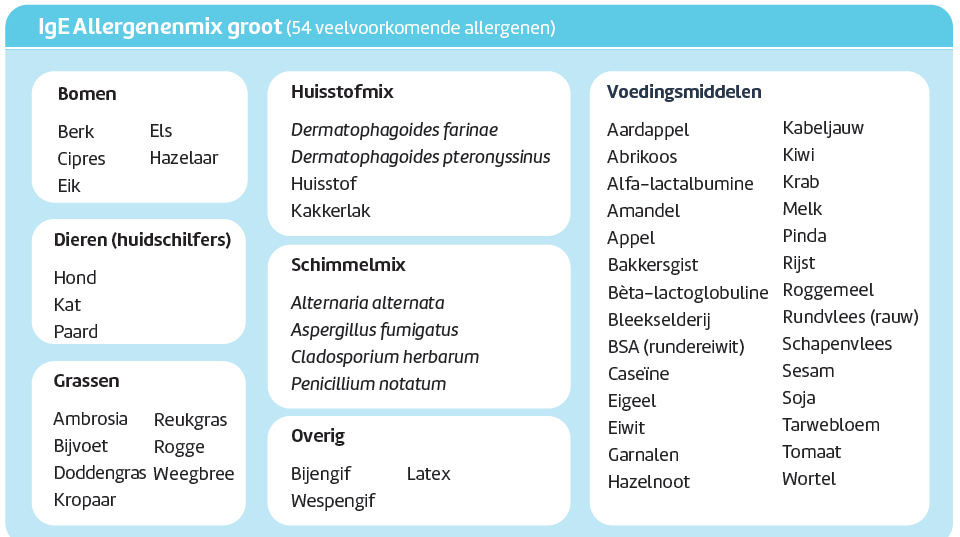
This test measures IgE antibodies against a large number of allergens in one go: both substances you breathe in, such as pollen, house dust mite, animal dander and mold spores, and foods such as cow's milk, egg, peanut, nuts, fish and shellfish. IgE is the type of antibody that, in an allergic reaction, prompts mast cells to release histamine. The body only makes these antibodies after earlier contact with the allergen; this is called sensitization. Each allergen gives a value in kU/l; which allergens are in the panel and from which value a result counts as positive is stated on the result report.
- Sensitization to one or more inhaled allergens from the panel
- Sensitization to one or more foods from the panel
- Support in investigating a suspected allergy, together with the story of the symptoms
High
A value above the cutoff for one or more allergens means that you have IgE antibodies against them: sensitization. This is not the same as an allergy. The more allergens are tested at the same time, the greater the chance that something comes out positive that has never bothered you. A positive result only counts if there has been a clear reaction to that allergen: symptoms in a particular season, on contact with an animal, or shortly after eating a particular food. Many positive results for nuts and fruit are due to cross-reaction with birch pollen and cause at most itching in the mouth or throat.
Low
Values below the cutoff mean that no IgE antibodies have been found for those allergens. An IgE-mediated allergy to those substances is therefore a lot less likely. Symptoms can also have other causes that this test does not find: a non-allergic inflammation of the nose, irritants such as smoke and cold, lactose intolerance, celiac disease or bowel complaints. Also, not every allergen is in the panel.
If your result is abnormal
The GP mainly looks at the story and puts the positive results next to it: only what fits the symptoms counts. With a matching result, advice follows on reducing contact with the allergen and, if needed, medicines. If a true food allergy is suspected or after a severe reaction, a referral follows to an allergist or pediatrician, where a food challenge test is done if needed.
Reliability
A positive IgE result shows sensitization, not allergy: it only says that there are antibodies, not that they give you symptoms. A result is only meaningful if it fits the story of the symptoms; a positive result from broad testing without matching symptoms can wrongly lead to a diagnosis of allergy. This risk is highest with a large panel: testing is done against dozens of allergens at the same time, so almost everyone gets something positive. In people without symptoms, the predictive value is low and no treatment follows a positive result.
Limitations
- The more allergens are tested at the same time, the greater the chance of a positive result without symptoms; with a large panel, this chance is considerable.
- Cross-reactions between different pollens and between pollen and food give many positive results that mean nothing clinically.
- According to the Dutch Society for Clinical Chemistry (NVKC), the level of the result says nothing about how severe a reaction would be.
- Symptoms that are not IgE-mediated, such as lactose intolerance, celiac disease or a non-allergic inflammation of the nose, are not found with this test.
How common is this
Allergy to inhaled allergens is common in the Netherlands; a true food allergy is much rarer than the suspicion of one. In both groups, sensitization is more common than the allergy itself. With a panel that tests against dozens of allergens at the same time, a positive result is therefore the rule rather than the exception, even in people without symptoms.
Who is this useful for
The result says the most when there are clear symptoms with a recognizable pattern: a particular season, a particular environment, contact with an animal, or a reaction shortly after eating a particular food. With vague symptoms without a pattern, or in people without symptoms, a broad panel adds little and mainly produces results that do not fit anything. The better the tested allergens fit the symptoms, the more a result says.
Downsides and risks
- A large panel almost always produces positive results that do not go with any symptoms. This can lead to unnecessarily cutting out foods, getting rid of a pet and an allergy diagnosis that is not there.
- Normal results do not rule out symptoms: non-allergic nasal symptoms, lactose intolerance, celiac disease and bowel complaints are not found with this test.
Sources
- NVKC, allesovertesten.nl: Allergie (RAST)
- FMS Richtlijnendatabase: Allergie van de bovenste luchtwegen, module Aanvullende diagnostiek
- FMS Richtlijnendatabase: Voedselprovocatie, module Plaatsbepaling diagnostiek voedselallergie
- NHG-Standaard Voedselovergevoeligheid en coeliakie (M47)
- Thuisarts.nl: Ik heb allergie
Always discuss an abnormal result with your GP. If a result is strongly abnormal, we try to reach you as soon as possible. Read your result yourself as well and contact your GP if in doubt. A test does not make a diagnosis. Read more about risks and results