Allergy and intolerance
IgE-allergenen mix klein
A panel of IgE tests against common inhaled allergens; shows sensitization, not allergy.
Everything about this testWhat it measures
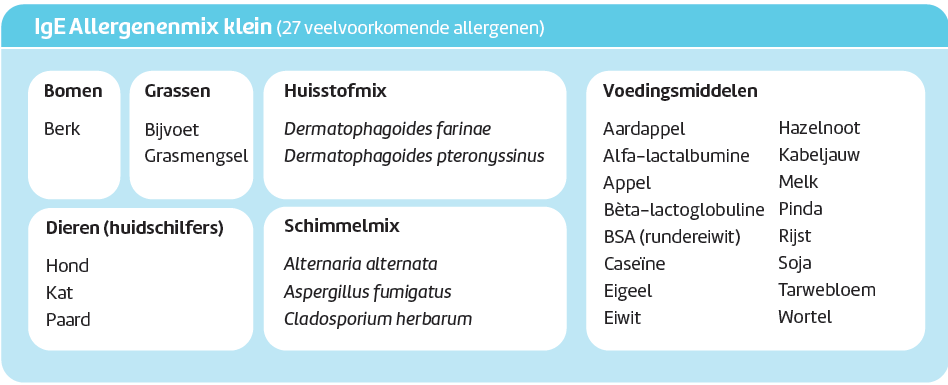
This test measures IgE antibodies against a range of allergens you breathe in, in one go: among others grass pollen, tree pollen, weed pollen, house dust mite, dander from cats, dogs and horses, and mold spores. IgE is the type of antibody that, in an allergic reaction, prompts mast cells to release histamine. The body only makes these antibodies after it has been in contact with the allergen before; this is called sensitization. Each allergen gives a value in kU/l; which allergens are in the panel and from which value a result counts as positive is stated on the result report.
- Sensitization to one or more inhaled allergens from the panel
- Support in investigating suspected hay fever or an allergy to house dust mite or pets, together with the story of the symptoms
- A starting point with nose, eye and airway symptoms that get worse in a particular season or in a particular environment
High
A value above the cutoff for one or more allergens means that you have IgE antibodies against them: sensitization. This is not the same as an allergy. If it fits the story, for example grass pollen with symptoms in May and June, or cat with symptoms when visiting someone who has a cat, the result supports the diagnosis. With a panel, however, the chance is high that something also comes out positive that has never bothered you; that is not a disease and is not treated. The level of the value says little about how severe the symptoms are.
Low
Values below the cutoff mean that no IgE antibodies against those allergens have been found. An allergy to those substances is then a lot less likely. Nose and airway symptoms can also have other causes: a non-allergic inflammation of the nose, irritants such as smoke, perfume, cold or dry air, chronic sinusitis or nasal polyps. Also, not every allergen is in the panel; an allergy to, for example, a rodent or a substance at work is not found with this test.
If your result is abnormal
The GP mainly looks at the story: when the symptoms occur, where they get worse and whether there is also asthma or eczema. With a positive result and matching symptoms, advice follows on reducing contact with the allergen and, if needed, medicines for the nose, eyes or airways. If the symptoms are not brought under control with this, a referral follows to an ENT specialist, lung specialist or allergist, where allergen immunotherapy may also be discussed.
Reliability
A positive IgE result shows sensitization, not allergy; the Dutch medical specialists' guideline (FMS) on upper airway allergy states this explicitly. A result is therefore only meaningful if it fits the story of the symptoms. With a panel, testing is done against many allergens at the same time, which considerably increases the chance of at least one positive result without symptoms. In people without symptoms, the predictive value is therefore low and no treatment follows a positive result. A positive result from broad testing without matching symptoms can wrongly lead to a diagnosis of allergy.
Limitations
- A panel tests against many allergens at the same time; the chance that something comes out positive without giving you symptoms is therefore high.
- Pollens cross-react with each other and with food; people who are sensitive to birch pollen often also have positive results for other tree pollens, nuts and fruit without being bothered by them.
- The result says little about the severity of the symptoms; a higher value does not automatically mean more trouble.
- Laboratories use different measuring methods and cutoff values; results from different labs cannot be compared one to one.
How common is this
Allergy to inhaled allergens is common in the Netherlands; hay fever and house dust mite allergy are at the top. Sensitization is even more common than the allergy itself: a considerable share of people with IgE antibodies have no symptoms from them. The symptoms usually start in childhood or as a young adult and often go together with asthma or eczema.
Who is this useful for
Useful with symptoms of the nose, eyes or airways with a clear pattern: a particular season, a particular place or contact with an animal. The result then helps to determine which allergen explains the symptoms and whether measures or immunotherapy are worthwhile. In people without symptoms, the panel adds nothing: sensitization without symptoms is not a disease, and a broad panel then mainly produces results that do not fit anything.
Downsides and risks
- A broad panel often produces positive results for allergens that do not give you symptoms. This can lead to unnecessary worry, getting rid of a pet or drastic measures in the home that achieve nothing.
- Normal results do not rule out nose and airway symptoms; there are also non-allergic causes that this test does not find.
Sources
Always discuss an abnormal result with your GP. If a result is strongly abnormal, we try to reach you as soon as possible. Read your result yourself as well and contact your GP if in doubt. A test does not make a diagnosis. Read more about risks and results