Urine tests
Urinekweek
Culture of bacteria from urine: which bacterium, how many, and which antibiotics it is sensitive to.
Everything about this testWhat it measures
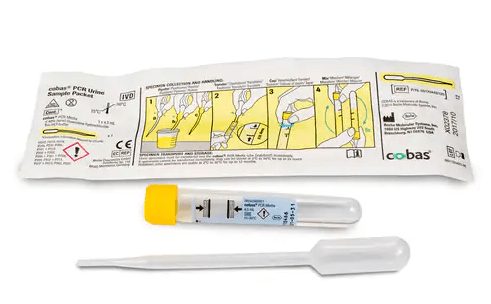
In a urine culture, the laboratory puts a small amount of urine on a growth medium and checks after 1 to 2 days which bacteria grow. It counts how many bacteria there are per milliliter of urine (the colony count), determines which species it is (identification), and, for a bacterium that can cause a urinary tract infection, tests which antibiotics it is sensitive to (antibiogram). The urine is collected at home and transferred to a tube with boric acid, a stabilizer that keeps the number of bacteria the same during transport to the laboratory.
- A urinary tract infection, such as a bladder infection, and the bacterium causing it
- Whether that bacterium is sensitive to the usual antibiotics, or insensitive (resistant)
- Bacteria in the urine without symptoms (asymptomatic bacteriuria)
Positive
A positive result means that bacteria have grown from the urine. With symptoms such as frequent and painful urination, abundant growth of one species of bacterium, usually E. coli, fits a urinary tract infection; the antibiogram shows which antibiotics work against that bacterium. How the colony count should be interpreted depends on the symptoms, the way the urine was collected, and any antibiotic use. Growth of several species of bacteria (mixed flora) usually fits bacteria from the skin or around the urethra that got into the container, and not an infection. Without symptoms, it is often bacteria in the urine without an infection, which mainly occurs in older people and outside pregnancy usually does not need treatment.
Negative
A negative result means that no bacteria, or very few, have grown. A bacterial urinary tract infection is then unlikely. The culture can be falsely negative if you were already taking antibiotics or if the urine had only been in the bladder for a short time, for example after drinking a lot. Symptoms when urinating can also have another cause, such as an STI (for example chlamydia or gonorrhea), which is not found with a standard urine culture.
Preparation
- Collect urine that has been in your bladder for at least 4 hours, preferably your first morning urine.
- Taking antibiotics? Collect the urine before you take the first tablet; during a course the culture is not reliable.
If your result is abnormal
With a positive culture and symptoms, the GP chooses an antibiotic to which the bacterium found is sensitive, or adjusts a treatment that has already started. With mixed flora or doubt, a new culture with properly collected urine usually follows. Bacteria in the urine without symptoms are usually not treated outside pregnancy; the laboratory reports a highly resistant bacterium (BRMO) separately on the result.
Reliability
According to the Dutch medical specialists' guideline (FMS) on urinary tract infections in adults, culture is the way to identify the cause and its sensitivity to antibiotics; the result is known after 1 to 2 days of growth. Reliability depends strongly on the collection: the guideline prefers first morning urine that has been in the bladder for several hours, and refrigerated transport or a tube with stabilizer, so that bacteria in the sample do not keep growing. According to the guideline, which colony count points to an infection differs by situation, for example with symptoms, the way of collection, antibiotic use, and pregnancy.
Limitations
- Antibiotic use at the time of collection can make the culture falsely negative or lower the colony count.
- Urine that has only been in the bladder for a short time is more likely to give a colony count that is too low; first morning urine or urine that has been in the bladder for at least 3 hours is preferred.
- Bacteria from the skin or around the urethra can get into the container and then give growth of several species (mixed flora); the result then cannot be assessed properly.
- With less than about 10 milliliters of urine in the boric acid tube, the stabilizer can be too strong and damage bacteria, which can make the culture falsely negative.
How common is this
Urinary tract infections are among the most common infections in general practice: according to NIVEL (Netherlands Institute for Health Services Research), depending on the group, 40 to 60 in 1,000 patients get one each year. Women get a bladder infection much more often than men. In half of women, a bladder infection clears up on its own within a week.
Who is this useful for
A culture is mainly useful with symptoms that fit a urinary tract infection and a higher chance of problems, such as in pregnancy, a weakened immune system (for example due to diabetes or medicines), a kidney or bladder disease or a bladder catheter, or when a bladder infection does not clear up after antibiotics. According to the Dutch GP guideline (NHG) on urinary tract infections, a culture is usually not needed for an ordinary bladder infection in a woman without such risks, and with symptoms of a bladder infection the GP is the first step. Without urinary symptoms, for example only with urine that smells different or is cloudy, a culture is pointless. With fever, chills, pain in the side, or feeling unwell, a doctor should see you the same day, without waiting for a culture result.
Downsides and risks
- Bacteria in the urine without symptoms are common, especially in older people; a positive culture can then lead to unnecessary antibiotic use, with side effects and a greater chance of resistant bacteria.
- Waiting for a culture result can delay the assessment of a bladder or kidney infection when there are symptoms that call for a quick assessment.
Sources
- NHG-Standaard Urineweginfecties (M05)
- FMS Richtlijnendatabase: Urineweginfecties (UWI) bij volwassenen, module Afnamewijze
- FMS Richtlijnendatabase: Urineweginfecties (UWI) bij volwassenen, module Gebruik stabilisator
- FMS Richtlijnendatabase: Urineweginfecties (UWI) bij volwassenen, module Uitwerken urinekweek
- Thuisarts.nl: Ik denk dat ik blaasontsteking heb (vrouw)
- Thuisarts.nl: Ik heb blaasontsteking (vrouw)
- NIVEL: Urineweginfecties, jaarrapport Peilstations 2015
Always discuss an abnormal result with your GP. If a result is strongly abnormal, we try to reach you as soon as possible. Read your result yourself as well and contact your GP if in doubt. A test does not make a diagnosis. Read more about risks and results