Vitamins, minerals and amino acids
Jodium
Iodine in urine shows how much iodine you recently took in; it is mainly a measure for groups, not for one person.
Everything about this testWhat it measures
The analysis measures how much iodine is excreted in the urine. Iodine is needed to make thyroid hormone. Dutch soil contains little iodine, which is why it is added to baker's salt. Most of the iodine you take in leaves the body through the urine within a day. As a result, the result mainly reflects the intake of the last day.
- The iodine intake of a group of people, measured as the median of the excretion
- A strongly abnormal intake in one person, for example after a contrast agent containing iodine or on a strict low-salt or low-iodine diet
High
A high value means you took in a lot of iodine shortly before the measurement. This is usually due to food, such as seaweed, fish and iodized salt, to supplements, or to a contrast agent containing iodine during a scan; after such a scan the value can stay raised for weeks to months. A lot of iodine at once can upset thyroid function in people with a thyroid condition. In someone without symptoms, one high value says little.
Low
A low value means you took in little iodine in the hours before the measurement. That can be due to eating little bread with iodized salt, a plant-based or low-salt diet, or simply drinking a lot. A low value is not a diagnosis of iodine deficiency: excretion varies so much from day to day that one measurement cannot say anything about it.
Preparation
- Do not eat for 8 hours before collecting the sample. Do not drink much the evening before, no more than 300 to 500 ml.
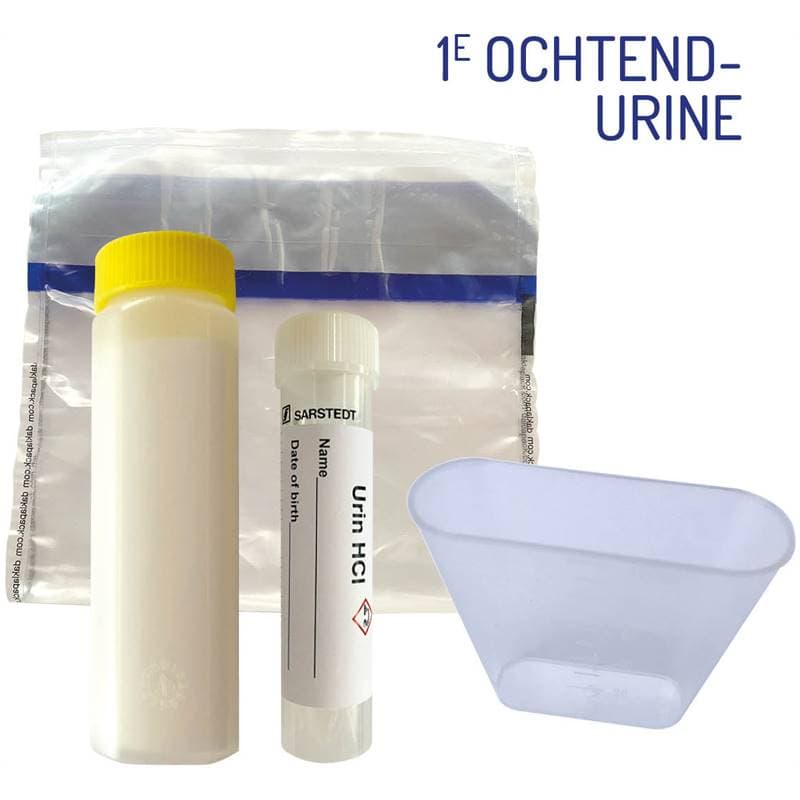
- Collect the first morning urine, the middle part of the stream.
- Do not eat fish or seafood in the 48 hours before.
- Do not collect urine during your period.
If your result is abnormal
With symptoms that fit a thyroid condition, the GP measures TSH and, if needed, free T4 in blood. An abnormal iodine excretion is not followed by any standard further testing.
Reliability
The WHO uses the median iodine excretion in urine as a measure of the iodine supply of a population, explicitly not as a test for one person. For one person, excretion varies so much from day to day and within a day that a single sample does not give a reliable picture. The RIVM (Dutch National Institute for Public Health and the Environment) writes that the most accurate way to determine a person's intake is measurement in urine collected over 24 hours. The WHO cut-off values apply to the median of a group and not to one person.
Limitations
- Excretion varies strongly by day and by sample; a single morning sample is not a measure of intake.
- Fluid intake determines the concentration; correction for creatinine or a 24-hour collection is needed to be able to compare.
- A contrast agent containing iodine during a scan raises the value for weeks to months afterwards.
- The result says nothing about how the thyroid works; that requires TSH and free T4 in blood.
How common is this
In the Netherlands, the soil, and therefore food, naturally contains little iodine; that is why iodine is added to baker's salt. In 2020 and 2021, the RIVM studied iodine excretion in 24-hour urine in 287 participants in the north of the Netherlands to map the intake of that group. Severe iodine deficiency does not occur in the Netherlands.
Who is this useful for
This test belongs in population research. For one person without symptoms, a single result says little. If you are worried about your thyroid, you need TSH in blood; if you are worried about your iodine intake, your eating pattern, for example bread with iodized salt, tells you more than a measurement.
Downsides and risks
- A low result can wrongly be read as iodine deficiency, after which supplements are used unnecessarily; too much iodine can actually upset the thyroid.
- The result can wrongly be seen as a test of thyroid function.
Sources
Always discuss an abnormal result with your GP. If a result is strongly abnormal, we try to reach you as soon as possible. Read your result yourself as well and contact your GP if in doubt. A test does not make a diagnosis. Read more about risks and results