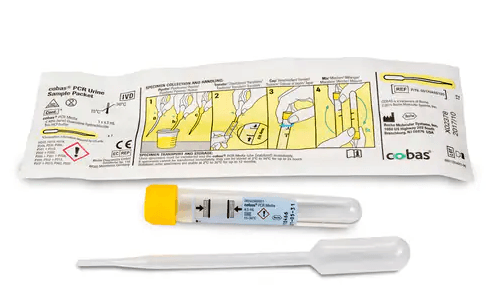
Urine
Cocaine
A urine test for benzoylecgonine, a breakdown product of cocaine. For monitoring your own use or a medical question; not a CBR or employer test.
€ 53,00
Your privacy
Necessary cookies keep the website working.
With your consent, we use additional cookies to:
We may share visited pages, interactions and device data with 5 service providers.
Hashed contact details are shared only with marketing consent.
You can change this later through Cookie preferences at the bottom of every page.
More information is available in our privacy policy.
Other analyses · Urine
A urine test for breakdown products of cocaine; shows whether cocaine has been used in the past few days.
At a glance
Cocaine (urine)
Explanation
Cocaine itself disappears from the body within a few hours. The body breaks cocaine down into, among other things, benzoylecgonine, which stays detectable in the urine much longer. This screening test looks for benzoylecgonine and related breakdown products. The laboratory uses a cut-off of 150 µg/l: if the concentration is above it, the result is positive. The test does not measure whether someone is under the influence at this moment.
Result
A positive result means there are breakdown products of cocaine in the urine above the laboratory's cut-off. After use, cocaine is usually detectable in urine for about 2 to 4 days; according to the Trimbos Institute, with heavy and frequent use this can increase to 1 to 2 weeks. A positive result does not say when, how much or how often cocaine was used, nor whether someone was under the influence at the time of the test. Cocaine used as a local anesthetic during a medical procedure on the nose or throat and tea made from coca leaves can also give a positive result. A positive result shows that a substance is in the body; it is not a diagnosis and says nothing about dependence.
A negative result means no breakdown products of cocaine were found above the cut-off. This does not completely rule out use: within about an hour of use, or if use was more than a few days ago, the result can be negative. With one-time or light use in diluted urine, the value can stay below the cut-off.
With a positive result that may have consequences, the laboratory has the result confirmed with a second method of analysis. The GP then looks at the context: amount, frequency, symptoms and any wish to cut down or quit, and refers to addiction care if needed.
Reliability
The test says something about use in the past few days, not about health or the extent of use. The Dutch Society for Clinical Chemistry (NVKC) states that a positive result of a screening test must be confirmed with a second, different method of analysis, because a positive result can have far-reaching consequences; for legal purposes this means confirmation with mass spectrometry (GC-MS or LC-MS). This test is not intended for an assessment or procedure of the CBR (Dutch driving license authority), an employer or the justice system: these have their own requirements for sample collection, identity checks and confirmation.
Who it is for
Useful for a medical question, for example in addiction care or with unexplained symptoms in which cocaine use may play a role, or for anyone who wants to monitor their own use. Not intended for an assessment or procedure of the CBR, an employer or the justice system: these have their own requirements. Anyone worried about their own use will get more out of help with cutting down or quitting than out of a test.
In 2024, 7.4 percent of adults in the Netherlands had ever used cocaine, about one million people. In the past year, 2.4 percent had used cocaine.
Trimbos Institute
Get tested
Cocaine (urine) is part of these test panels. You order online and have your blood drawn at a collection point or collect the sample at home.
Evidence
This explanation is based on Dutch guidelines and independent information. It is general information, not a diagnosis. Discuss an abnormal result with your GP.
More about risks and results